If you’re like me and collecting articles about how AI will make us dumber, you will notice that nine out of ten will make reference to a certain story in Plato’s Phaedrus. If you aren’t familiar, here’s my abridged version:
The King of Egypt, Thamus, was visited by Thoth, the god whose domain spanned knowledge, mathematics, geometry and astronomy. Thoth, feeling generous, lays out all of his technical inventions to bequeath to the Egyptians. Thamus looks them over, pointing at this and asking about that like he’s at a bazaar. The King comes to letters and writing. Thoth tells Thamus that this invention will make Egyptians wiser and improve their memory. The King thinks for a second, and replies, “Your invention will produce forgetfulness in the souls of those who have learned it, through lack of practice at using their memory…you give an appearance of wisdom, not the reality of it.”
It’s a great anecdote, and the soundbite is undeniably super relevant today, but we rarely hear about this Thoth character. He seems fascinating, with all of his inventions and gadgets. Was he like the original Egyptian tech bro?
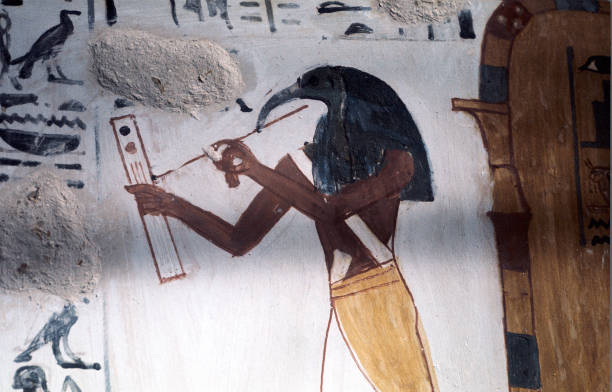
Plato’s Socrates says Thoth (or Theuth or Tehuti) was “the first to discover number and calculation, and geometry and astronomy, as well as the games of draughts and dice and, to cap it all, letters.” The Greeks associated him with Hermes. He was the god of knowledge but also associated with the moon and the judgement of the dead. Seems that he was a bit of a polymath. If you take all of these domains together and squint, you can kind of see how the Egyptians viewed this character back in their day, and how, if Thoth had been born today, he would have attended Stanford and gone on to work at a Silicon Valley startup.
Why the association with the moon, though? This is pure speculation on my part, but I would guess that it was because the moon governed the Nile’s floods, which, for the Egyptians meant literally life and death. So tabulating these patterns was critical to their ability to predict when to plant and when to harvest. I’m neither an Egyptologist or a historian, but I’m pretty sure these cycles and the know-how needed to accurately forecast these major celestial events were available only to a small priestly class. In this light, Thoth being attributed the discovery of number and calculation, geometry, astronomy, and writing all tracks.
Okay, then what about draughts and dice? How do they relate?
According to Plutarch’s account, the Egyptian calendar had 360 days. The story goes that Ra, the sun god, had placed a curse on the sky goddess, Nut, so she could not give birth on any day of any month of the year. But she was pregnant. With quintuplets. Osiris, Horus the Elder, Set, Isis, and Nephthys, were waiting in the wings to be born. So because of Ra’s curse, she was stuck in a holding pattern, past her due date, and could not deliver.
Along comes Thoth to save the day (or days in this case). He goes to the Moon (aka Khonsu) and challenges him to a game — Plutarch says draughts but most likely he was referring to senet, an Egyptian form that was the ancestor of checkers. Incidentally, senet is played on a 30-square board arranged in three rows of ten, which lines up with the old Egyptian calendar which had 30 days for each of the 12 months.
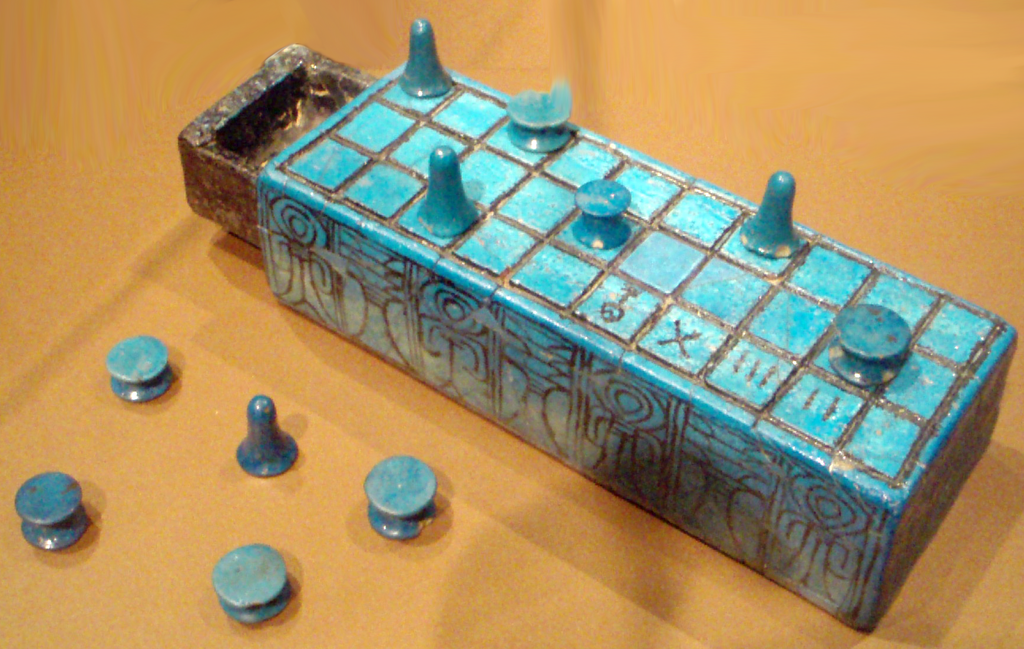
So Thoth challenges the Moon. The stakes? Light. Not light as in pennies, but actual light, from the Moon. Thoth, being the god of senet, starts steadily racking up the wins, and with each win he gets a seventieth of the Moon’s total illumination.Plutarch's text says "a seventieth part," but the math doesn't quite work: 360 × 1/70 = 5.14, not 5. The Renaissance scholar Joseph Scaliger proposed emending it to "a seventy-second part" (360 × 1/72 = 5 exactly). Most modern editions keep the original "seventieth" — either Plutarch rounded, or the mythic round number mattered more than the arithmetic. Eventually, when his winnings total five full days’ worth of light, he stops. And this is why, according to this Egyptian myth, the Moon waxes and wanes rather than shining at full brightness every night. And on each of the five extra days, Nut was able to give birth to one of her quintuplets.
There are so many facets of this story that fascinate me. Thoth is a trickster figure. He hustles the Moon! The Greeks likened him to Hermes, their trickster god. There’s something else Thoth is the god of, or at least associated with: systematizing. Think about it: how do you always win at games? How do you predict when the Nile is going to flood? You figure out the system, through calculation, numbers, probability, and writing everything down.
The story about tricking five days from the Moon also points to something else: when Thoth gives writing to Thamus, he calls his invention a “pharmakon” — in Greek, φάρμακον, which has three distinct meanings: poison, medicine or remedy, and drug. It’s a profoundly rich word because it contains all three ideas, and in them, the larger idea that in different doses or wielded by different people with different intentions, these things can be healing or deadly.
The pharmakon is Thoth’s modus operandi. What he gives us contains both a poison and a cure, and in that sense, I would also put technology on his CV. The five bonus days he steals were considered slightly dangerous, probably like our Friday the 13th, because they were liminal, outside “normal” time. It’s likely that this myth was used to patch the Egyptian civil calendar, which was a solar calendar, 360 days, 12 months of 30 days each, used for administrative and agricultural planning. 360 is a nice round number, but it’s actually too short, and the Egyptians knew it. After centuries of using it, they could no longer tolerate the drift. So the five epagomenal (bonus) days Thoth won were grafted onto the regular calendar, similar to our Leap Year or Daylight Savings Time.
It’s interesting that Thoth was associated with such a curious range of things: the moon, numbers, calculation, draughts, wisdom, writing, magic, knowledge. The Egyptians were obviously trying to attach him to some common phenomenon underlying these things. To me, Thoth’s true domain is systems. But also by his actions and his words, he reminds us that systems, even ones that he creates, are always imperfect approximations of reality. The calendar is a system. Writing is a system. Games are systems. They set up an abstraction, a representation and we use and play within them, but they are necessarily imperfect. The game philosopher, Bernard Suits, said that “games are voluntary acceptance of unnecessary obstacles.” The frictions, the obstacles we accept, are the game.